LED Lighting Solutions
LED Stadium Lights: Performance, Efficiency, and ROI for Sports Venues

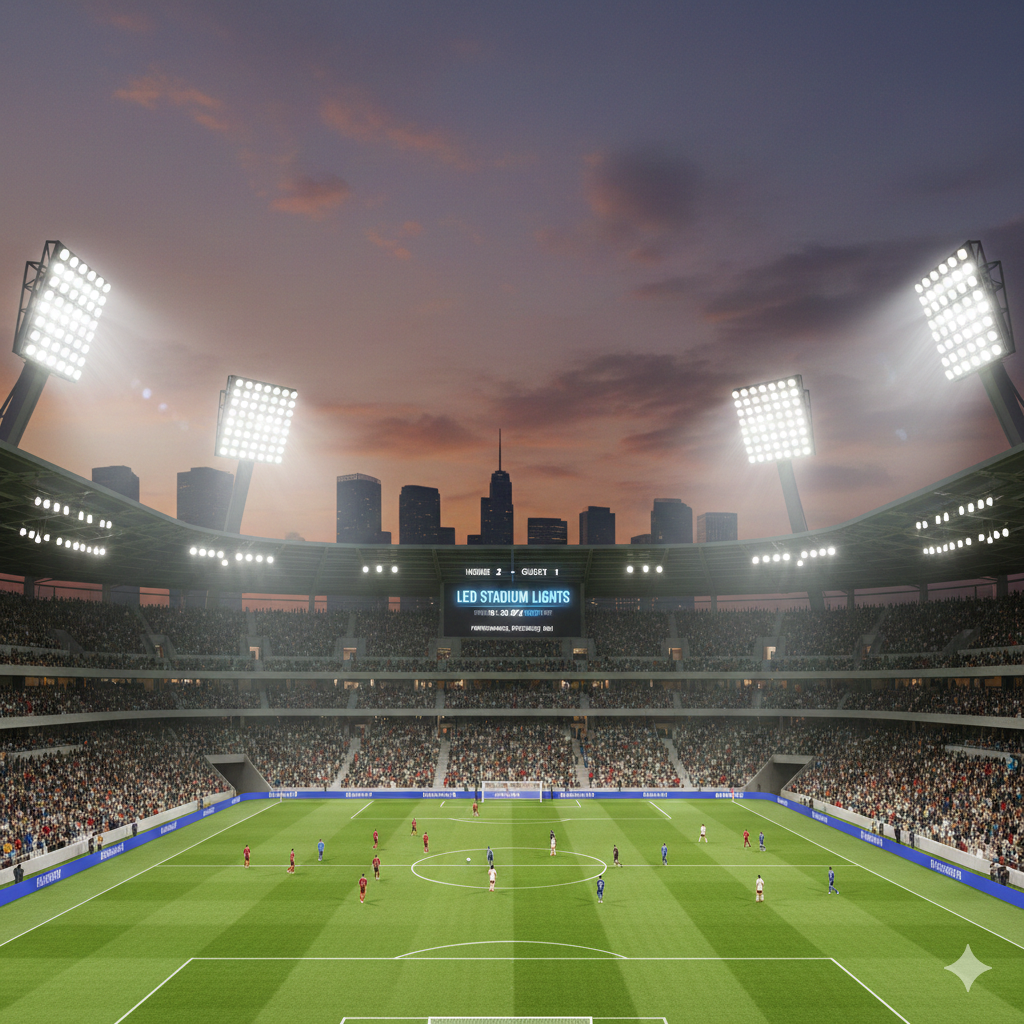
LED stadium lights are solid-state fixtures. They replace older metal halide systems. Metal halide needs 15-30 minutes to warm up. LED stadium lights turn on instantly. This matters for broadcasting. Players need immediate visibility. Sports events cannot wait for warm-up delays.
The beam width of LED stadium lights ranges from 15 to 120 degrees. Narrow beams concentrate light. Wide beams spread illumination. Stadium managers select beam angles based on pole height and field size. A 30-degree beam works well for poles at 50-80 feet. A 60-degree beam suits lower installations.
LED stadium lights operate at 100-277 volts or 277-480 volts. Voltage selection depends on facility infrastructure. Most stadiums use standard 277-volt systems. Some facilities have upgraded to 480-volt configurations. Higher voltage reduces transmission losses.
Brightness Specifications and Lumen Output
LED stadium lights produce 60,000 to 150,000 lumens. Output depends on wattage. A 500-watt LED stadium light generates 70,000-80,000 lumens. A 1200-watt model produces 160,000+ lumens. Lumens measure total light output. Footcandlesmeasure light reaching the ground. These are different measurements. Designers must calculate both when planning installations.
Professional baseball requires 150 footcandles minimum. Football needs 100-125 footcandles. Soccer fields require 80-100 footcandles. Recreational facilities need 30-50 footcandles. Broadcast events require 200+ footcandles. Light distribution matters more than raw lumens. Uneven lighting creates shadows. Shadows reduce visibility. Players cannot see clearly in dark zones.
A single LED stadium light cannot illuminate an entire field. Multiple fixtures work together. Most stadiums use 12-20 LED stadium lights. The number depends on field dimensions. Proper spacing prevents gaps. Overlapping coverage creates uniform brightness.
Energy Consumption and Operating Costs
Metal halide fixtures consume 1000-1500 watts per bulb. LED stadium lights consume 300-1200 watts. The reduction is 60-80%. A facility with twenty 1500-watt metal halide lights uses 30,000 watts. The same facility with LED stadium lights uses 8,000-12,000 watts. That saves 18,000-22,000 watts continuously.
Annual savings depend on operating hours. A stadium running lights 300 hours yearly saves $3,000-5,000. A facility using lights 1,500 hours yearly saves $15,000-25,000. Industrial parks and large complexes save $50,000+. These are real numbers. Installation costs typically recover in 2-4 years.
Metal halide fixtures also waste energy as heat. LED stadium lights stay cool. Less cooling cost in summer. Air conditioning expenses drop. Building maintenance decreases. Roof-mounted fixtures transfer less heat to structures. This extends roof lifespan. It reduces HVAC strain.
Durability and Maintenance Requirements
LED stadium lights last 100,000 hours at 70% brightness. Metal halide lasts 15,000-20,000 hours. LED stadium lights live 5-6 times longer. Extended lifespan means fewer replacements. Replacement requires bucket trucks. Bucket truck rental costs $500-1000 per service. An electrician charges $200-500. Multiple replacements cost thousands annually.
LED stadium lights fail gradually. They dim over years. Metal halide fails suddenly. The bulb dies. No warning. The entire stadium goes dark. Sudden failure is dangerous. Gradual dimming allows planning. Facility managers can schedule replacements. No emergency calls needed.
Weather resistance matters for outdoor fixtures. LED stadium lights handle extreme conditions. They work in cold climates. High-altitude installations are possible. Salt spray environments in coastal areas require corrosion-resistant housings. Dust storms do not damage sealed LED designs. These fixtures survive where metal halide systems fail.
Sealed LED housings prevent moisture entry. Water damage causes immediate failure. Ice buildup is less likely. Thermal cycling from -40°C to +50°C does not damage modern LED stadium lights. Vibration from wind or earthquakes poses no threat. The solid-state design has no moving parts.
Beam Angle Selection for Specific Applications
A 20-degree beam concentrates light tightly. Use this at 80-100 feet height. Coverage area is small. But brightness is intense. This works for narrow field sections.
A 30-degree beam is the industry standard. It suits 50-80 feet installations. It covers wider areas than 20-degree. Intensity remains adequate. Most stadiums use this angle.
A 40-degree beam spreads light broadly. Install at 40-60 feet heights. Coverage expands. Intensity decreases slightly. Smaller fields benefit from this angle.
A 60-degree beam illuminates very wide areas. Use at 30-40 feet. Tennis courts and parking lots work well. Field shadows increase. Multiple fixtures are necessary.
Mixing beam angles improves results. Install 30-degree fixtures at main positions. Add 40-degree units for edges. This creates smooth transitions. No dark spots appear. No overly bright zones exist.
Light Quality and Color Temperature
LED stadium lights emit 5000K color temperature. This matches daylight. The human eye perceives neutral white light. Metal halide also produces 5000K. But LED render colors more accurately. Grass appears greener. Player jerseys show true colors. Broadcasts look natural.
Color Rendering Index (CRI) measures color accuracy. LED stadium lights achieve 80-90 CRI. Metal halide reaches 70-75 CRI. Higher CRI means better visibility. Players can judge distances accurately. The ball is easier to track. Spectators enjoy better view quality.
Glare happens when light scatters. Poor optics cause glare. LED stadium lights use precision lenses. Light rays point downward. Minimal light goes sideways. Players face less glare. Spectators in stands see less harsh light. This improves comfort. It reduces eye strain.
Application-Specific Performance Data
Baseball fields have unique requirements. The pitcher mound needs bright light. Outfield areas require even illumination. Infielders see ground clearly. Spectators cannot see if infield is shadowed. LED stadium lights with mixed beam angles solve this. A 20-degree fixture on one pole focuses on the mound. A 40-degree fixture illuminates outfield. Together they create balance.
Football stadiums need large overall brightness. The entire field must be equally bright. No shadows at yard lines. Goal posts need clear visibility. LED stadium lights at 60-80 feet height with 30-degree beams work well. Eight fixtures minimum.Twelve is better.
Soccer requires 80-100 footcandles across the entire field. The ball must be visible at all times. Players run constantly. Poor lighting causes injuries. Uneven brightness affects gameplay. LED stadium lights provide consistent illumination. Five-fixture setups work for small fields. Fifteen fixtures suit professional facilities.
Tennis courts need high brightness at playing height. The court is narrow. The ball moves fast. Players need 75-100 footcandles. LED stadium lights at 35-40 feet with 40-60 degree beams work well. Four fixtures per court. Glare reduction is critical. Tight beam angles prevent spill light.
Installation Considerations and Mounting Options
Flood-mount brackets secure LED stadium lights to poles. They allow angle adjustment. Installation takes 30-60 minutes. Slip-fit mounts require no tools. The fixture slides onto a standard tenon. Quick installation is possible. No drilling needed. Both methods work equally well.
Yoke mounts offer flexibility. The light rotates in any direction. Complex stadium layouts benefit. Multiple adjustment options prevent shadows. Yoke mounts cost more. They suit difficult installations.
Pole height affects beam angle selection. 40-foot poles need 40-50 degree beams. 60-foot poles need 30-degree beams. 80-foot poles work with 20-degree beams. Light spreading increases with distance. Math determines proper angles. Taller poles require narrower beams.
Foundation requirements are critical. Poles must handle wind load. LED stadium lights are heavy. A 1200-watt fixture weighs 80-100 pounds. Wind force creates lateral stress. Concrete footings must be deep. Specifications vary by region. Hurricane zones need stronger anchoring. Snow load areas require wider bases.
Installation Timeline and Construction
Electrical work precedes light installation. Wiring must handle high current. 500-watt LED stadium lights need 4-5 amp circuits. 1200-watt fixtures require 10+ amps. Undersized wiring causes voltage drop. Voltage drop reduces brightness. Proper sizing prevents problems. Experienced electricians calculate requirements.
Conduit installation takes 2-4 weeks for large facilities. Trenching can be extensive. Underground routing is safer than overhead. Ground conditions affect timeline. Rocky soil takes longer to trench. Sandy soil is faster. Bedrock stops digging. Alternate routing becomes necessary.
Fixture installation requires bucket trucks. Most contractors charge $100-200 per hour. A 12-light system takes 20-30 hours. Labor cost is $2,000-6,000. Equipment delivery adds time. Scheduling around weather matters. Rain delays installation. Wind makes work dangerous. Optimal conditions accelerate completion.
System testing follows installation. Each light receives individual adjustment. Levels are confirmed with light meter. Uniformity is verified across the field. Bright spots get corrective lenses. Dark zones get additional fixtures. Fine-tuning takes 1-3 days. Results determine user satisfaction.
Regulatory Compliance and Standards
The Illuminating Engineering Society (IES) sets standards. LED stadium lights must meet RP-6. This covers sports lighting. Specific footcandle requirements exist. Uniformity ratios are defined. Glare limits are established.
Dark Sky Compliance affects installations. Uplight limits apply in many regions. Light trespassing to neighbors must be minimized. Proper aiming prevents sky glow. Directional fixtures help compliance. Some stadiums face restrictions. LED stadium lights support compliance better than metal halide because they direct light downward efficiently.
National Electrical Code (NEC) governs wiring. Grounding is mandatory. Surge protection is required. Disconnect switches must be accessible. Safety certifications are needed. UL-listed fixtures meet standards. Third-party testing verifies specifications.
Local building codes vary. Zoning may restrict installation heights. Setback requirements exist. Some areas limit brightness. Permits are mandatory. City approval takes weeks. Planning ahead prevents delays.
Conclusion
LED stadium lights deliver measurable performance benefits. Energy consumption drops 60-80%. Lifespan extends 5-6 times longer. Light quality improves noticeably. Return on investment occurs in 3-5 years. Operating costs fall dramatically.
The technology is mature. Reliability is proven. Performance is verified. Thousands of installations worldwide confirm results. Sports facilities, airports, parks, and industrial sites use LED stadium lights successfully. The shift from metal halide is complete.
Future installations will use LED exclusively. Metal halide is obsolete. The transition is already happening. Early adopters realize maximum savings. Standard retrofit projects save substantially. New construction specifies LED exclusively. The industry consensus is clear: LED stadium lights are superior.

-

 Law3 months ago
Cnlawblog: Your Go To Resource for Legal Updates
-

 Technology3 months ago
Hypackle: Revolutionizing Team Communication in the Digital Age
-

 Blog3 months ago
NHentai.nef: The Ultimate Resource for Doujinshi Enthusiasts
-

 Digital Marketing3 months ago
Troozer com: Your Ultimate Guide to Online Shopping
-

 Blog3 months ago
LexatSmallville: Intersection of Friendship and Rivalry in Smallville
-

 Blog3 months ago
Lufanest: How It Influences Culture and Society Today
-

 Technology3 months ago
Miuzo: The Next Big Thing in Digital Innovation
-

 Lifestyle3 months ago
Itzhak ezratti wife: A Journey of Love and Resilience